OUTSIDE AGITATOR
Collaborative project with Patrick Rearden and Jasper Townsend for The Architecture League of New York and Construction Workers United October 2025 Sign+Line Competition calling for designs to protect construction sites from enforcement actions from U.S. Immigration and Customs Enforcement (ICE)
Architectural devices that mediate between the inside and outside, also articulate these states themselves.¹ As we consider the anxieties that produce isolationist politics and enclosures at the national scale, we must also take into account the damage the image of militarized enclosure inflicts on our local communities. The construction of walls and borders carry a symbolic weight in cultivating a fear of the “other. ” ² At the national scale, the collective fears generated by and projected onto border walls subject marginalized communities domestically to xenophobic violence and public divestment. ³ This project seeks to rethink protection as an infrastructural practice at the hyperlocal scale of the construction site, creating enclosure and policy to safeguard our neighbors from the unchecked violence of ICE.
Our proposal seeks to leverage the perceived officiality of scaffolding, given its ubiquitous presence on construction sites and urban environments alike. Scaffolding is a strong, temporary, and flexibly deployable system that can be adapted for new uses, blending in with its surrounding context while signaling legitimacy. To strengthen the autonomy of undocumented workers on these sites, precariously operating outside of legal protections, we propose a publicly accessible signage design template that does not require oversight or the distribution of materials from a governing entity, so as to not limit the scope of its deployment nor subject these sites to bureaucratic delay in the design’s rollout.
Foundational to this approach is an understanding that we cannot rely on architectural organizations to oppose this administration, much less to develop policy or sustain funding that protects the discipline’s most vulnerable from detainment and aggression by ICE and Trump’s expanding deportation agenda. This was made clear by Robert Ivy’s shameful statement following President Trump’s 2016 campaign, declaring that the AIA stood “ready to work with him and with the incoming 115th Congress” after Trump’s $500 billion infrastructure pledge, without challenging his platform’s commitment to xenophobic infrastructure and development projects including the militarization of the US-Mexico border wall. ⁴ To design within this system and within this moment, is to consider not only the design object that is to be produced, but the mechanisms, and potential bureaucratic obstacles, of its production and distribution. Realistically, the design must be able to be fabricated from readily available materials quickly and with ease, without depending on authorization or instruction from any authority.
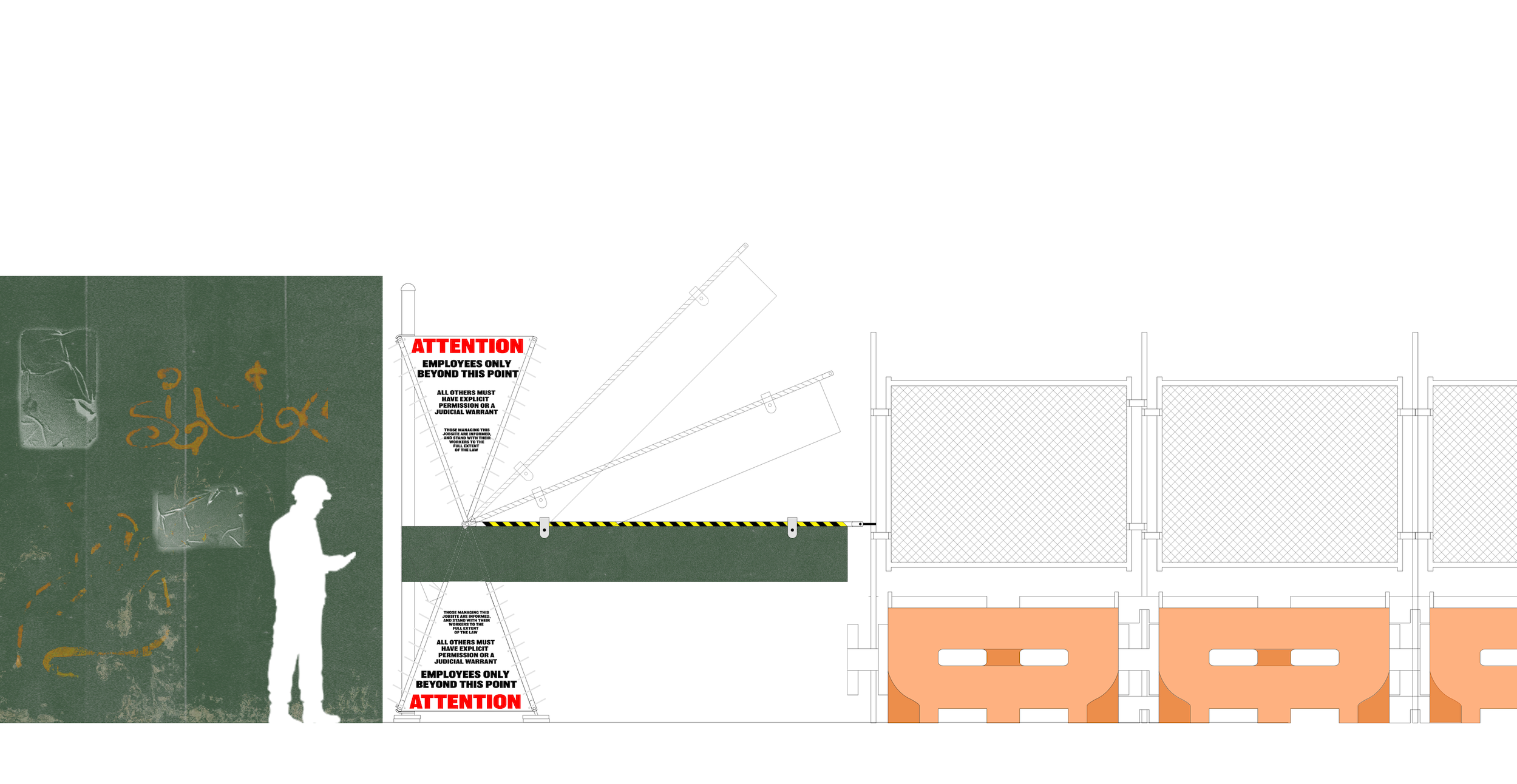
Our design hinges on two critical components: readymade, standardized diagonal braces found in scaffolding systems and its corresponding connection parts—both available in surplus on construction sites. The second component is a plotter-printed Tyvek sign, the only part that cannot be fabricated on site. For this, we propose a contractual amendment for architects designing on the site to print and provide signs as part of the physical drawing set. This amendment creates a contractual duty for architects to ensure the welfare of those whose labor makes their projects possible. The bureaucracy of architecture becomes a means to embed legal protections for those otherwise excluded from rights and protections under US law.
The sign utilizes a pre-existing pin connection found on the diagonal braces to direct its form, latching on to existing fences. Inside the job site, the sign informs workers of their legal rights, undocumented or otherwise, as stated by the National Immigrant Justice Center. Outside the job site, the sign clearly indicates that only workers are allowed beyond it, unless others have explicit permission or a judicial warrant. Architects produce drawings; instructions for carrying out labor. These instructions and their afterlives are filtered through complex bureaucratic and financial structures, alienating designers from the material and political dimension of the work. This project proposes greater proximity between designer and producer, transfiguring a standardized, bureaucratic aesthetic into one of protection and mutual care.
¹ Siegert, Bernhard. Cultural Techniques: Grids, Filters, Doors, and Other Articulations of the Real. Translated by Geoffrey Winthrop-Young, Fordham University Press, 2015.
² Brown, Wendy. Walled States, Waning Sovereignty. Zone Books, 2010.
³ Cruz, Teddy, and Fonna Forman. “Unwalling Citizenship.” The Avery Review, no. 21, Jan. 2017, https://www.averyreview.com/issues/21/unwalling-citizenship.
⁴ “Architects Are Upset Over an AIA Letter to Donald Trump.” Bloomberg News, 15 Nov. 2016, https://www.bloomberg.com/news/articles/2016-11-15/architects-are-upset-over-an-aia-letter-to-donald-trump
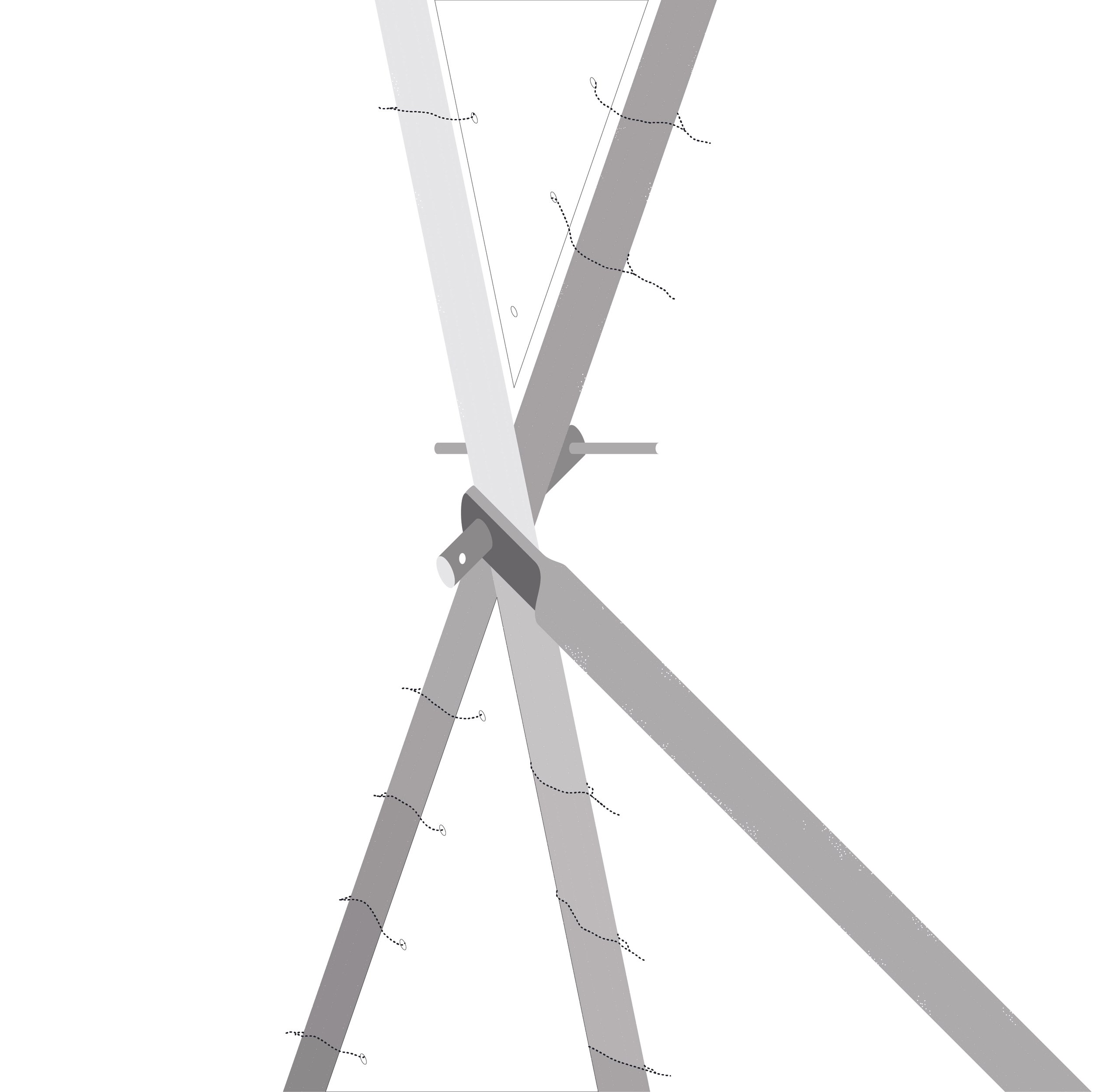
Pin connection detail, ziptie connection detail
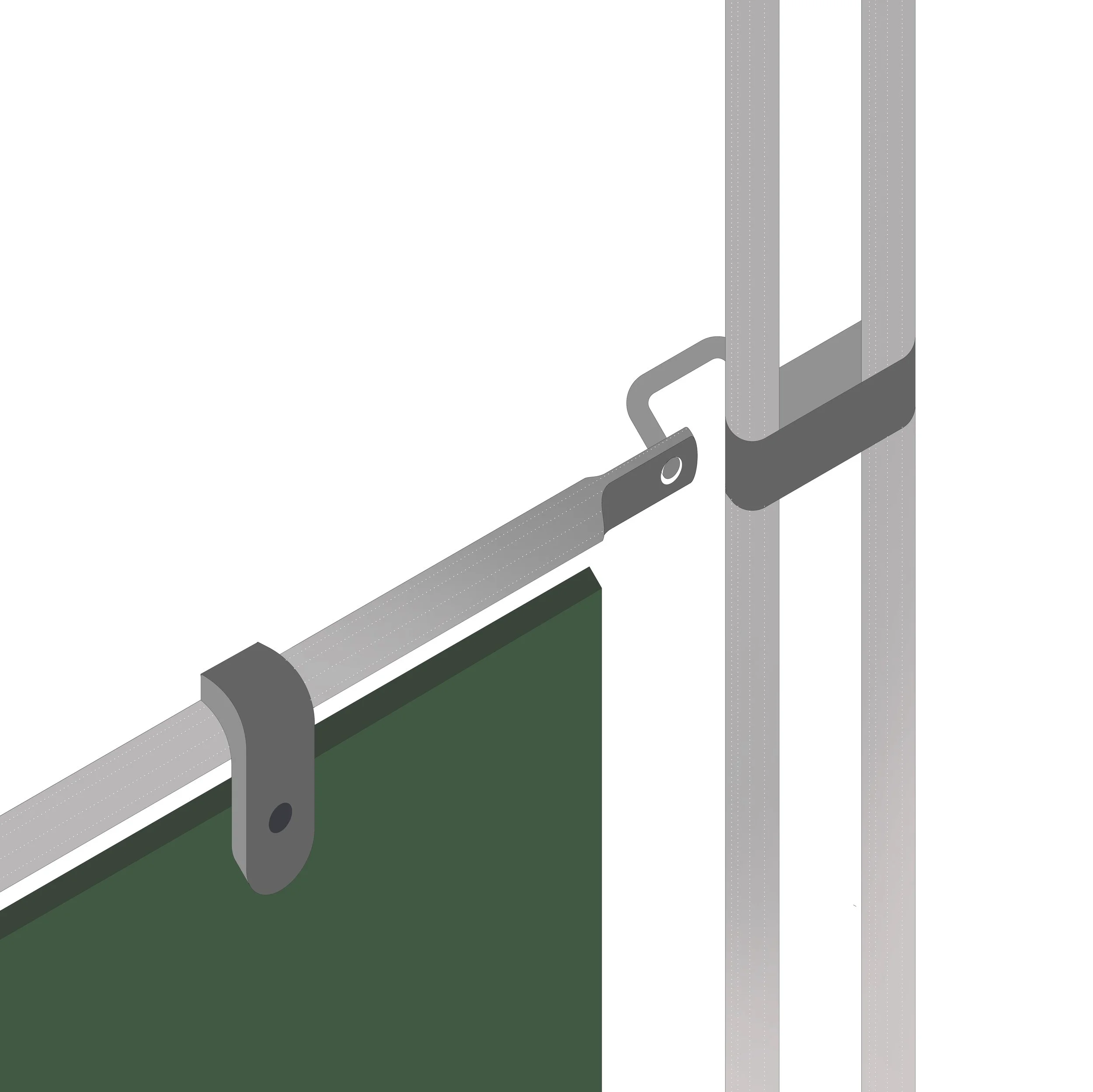
pigtail connection detail, latch closure
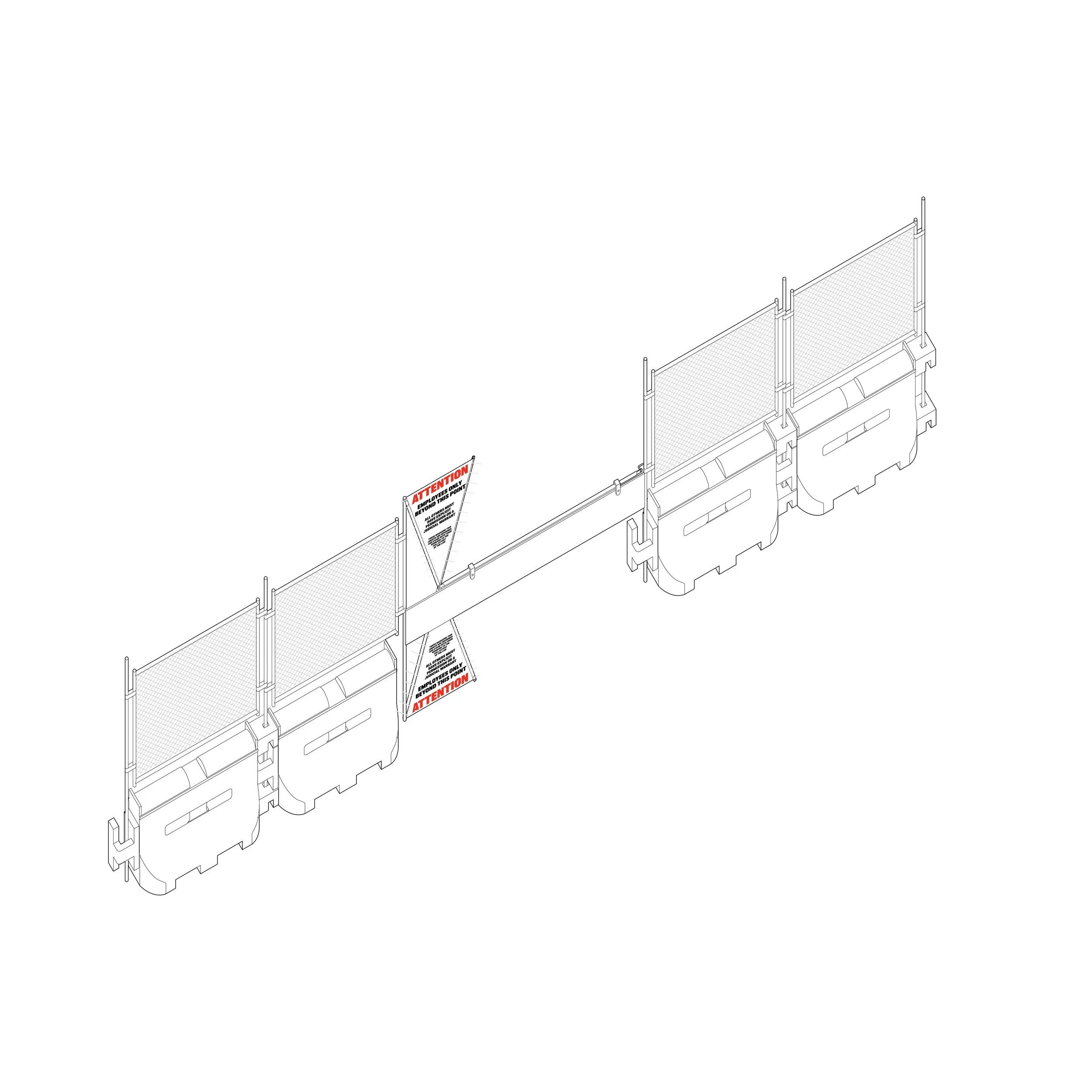
Axonometric drawing showing sign attached to fence and construction barriers
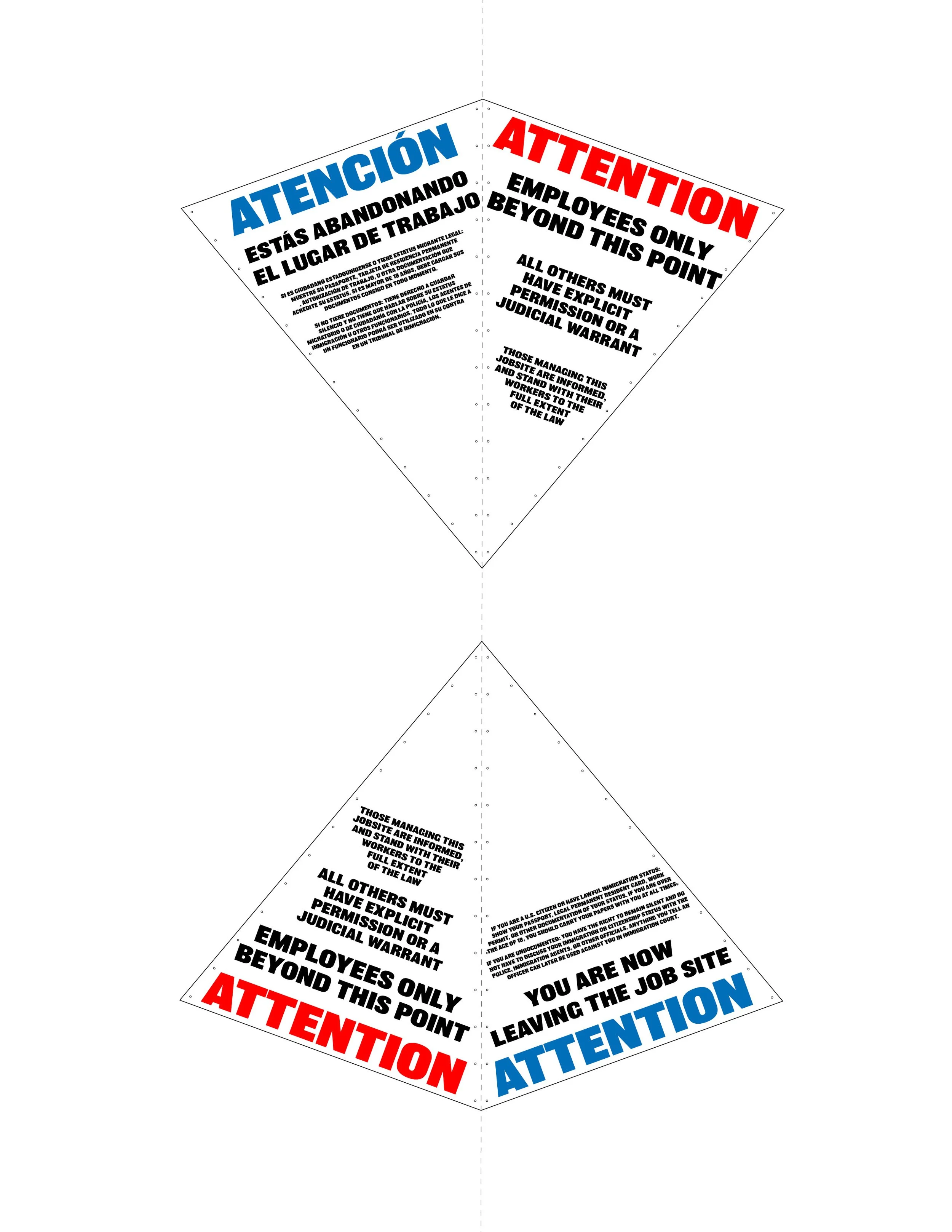
Tyvek print out to be cut, folded, and tied onto diagonal members